Work Run Correction Lifecycle
Use this page when an operator needs the human review flow for a Compliance Work Run correction. Developer route details stay in the correction API pages; this guide explains what the operator sees, what state means, and which proof boundary must stay visible from submitted correction to applied, rejected, or superseded correction state.
Current status: public source docs may describe the Work Run correction lifecycle, but the admin Work Control browser-path smoke evidence remains pending. Do not present this page as final UI proof, legal approval, hosted docs availability, OpenAPI-generated SDK availability, or production install evidence.
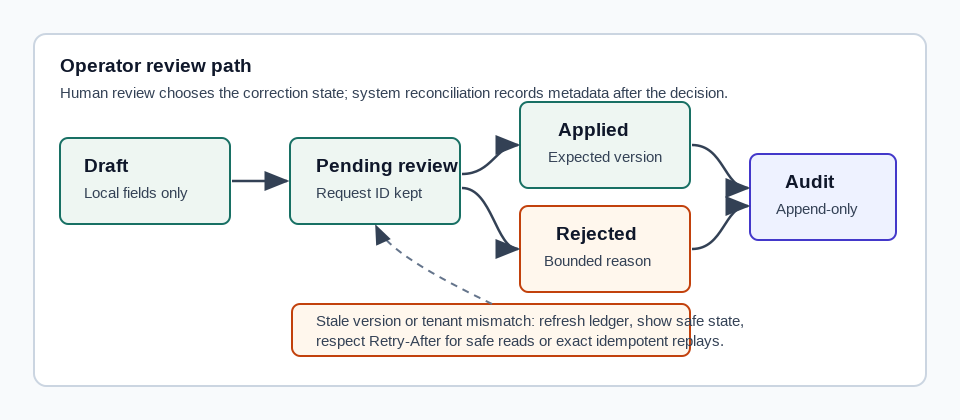
Operator State Model
| State | Operator meaning | Safe next step |
|---|---|---|
draft |
A permitted operator is editing supported correction fields before submission. The draft belongs to the current review task and should stay local until the operator submits or discards it. | Compare original versus proposed language, keep customer text out of public notes, then submit one pending correction action. |
pending review |
The correction has been recorded for the Work Run and is waiting for a permitted reviewer decision. | Refresh the correction ledger before apply or reject, and show the reviewer the inspected expected version. |
applied |
A permitted reviewer accepted the pending correction because the reviewed evidence supports the narrower replacement. | Treat the applied row as append-only history and continue the Work Run approval or block decision from the refreshed ledger. |
rejected |
A permitted reviewer kept the original reviewed record because the proposed correction was unsupported or invalid for the evidence. | Keep the rejected row visible as metadata-only history with a bounded reason code. |
superseded |
A later appended correction replaced the effect of an earlier correction row. | Keep the superseded row visible as append-only metadata and continue from the refreshed ledger. |
stale-version refresh |
The pending correction no longer matches the version the reviewer inspected. | Reload correction history, compare the latest correction_sequence or expected version, and ask the reviewer to choose again. |
retry-after wait |
The platform asked the client to slow down a safe read or exact idempotent replay. | Respect Retry-After; do not create a new review action while the previous write result is unknown. |
Human Review Versus System Reconciliation
| Concern | Human correction review | System reconciliation |
|---|---|---|
| Decision owner | A permitted operator or reviewer decides whether the changed wording is supported by the inspected evidence. | The platform records request metadata, sequence, receipt, and audit metadata after the human action. |
| Draft handling | The operator may edit supported draft fields before submission and may discard the draft. | The system must not rewrite submitted correction history to make the review look cleaner. |
| Pending review | The reviewer compares the original and proposed summaries against the evidence they can inspect. | The ledger exposes metadata such as correction id, status, sequence, request ID, and receipt type. |
| Apply, reject, or request retry | The reviewer chooses one valid transition for the pending correction or requests a follow-up row. | The platform enforces expected-version checks and records append-only applied, rejected, superseded, or new pending rows. |
| Failure handling | The operator sees role-safe messaging and decides whether to refresh, wait, discard, or submit a new action. | The platform returns bounded Problem categories, Retry-After hints, and request IDs without leaking tenant data. |
Checked Fixture Names
Use checked fixture names when documenting idempotency, expected-version, Problem handling, redaction, or auditability. The fixtures are named in the Correction API error guide and their operator-safe remediation is summarized in the Problem variant matrix.
| Lifecycle step | Checked success fixture | Checked Problem fixtures to cite | Operator boundary |
|---|---|---|---|
| Submitted as pending | work-run-correction.create.success.v1 |
work-run-correction.create.validation-failed.v1, work-run-correction.create.idempotency-conflict.v1, work-run-correction.create.rate-limited.v1 |
Submit one pending correction action with one idempotency key. Create does not use Expected-Version; exact replay is allowed only for the same body, target, and key. |
| Ledger refreshed | work-run-correction.list.success-page.v1 |
work-run-correction.list.invalid-cursor.v1, work-run-correction.list.forbidden.v1, work-run-correction.list.tenant-mismatch.v1, work-run-correction.list.rate-limited.v1 |
Safe reads may respect Retry-After; cursor values and cross-tenant existence hints stay out of public notes. |
| Applied by reviewer | work-run-correction.apply.success.v1 |
work-run-correction.apply.validation-failed.v1, work-run-correction.apply.version-conflict.v1, work-run-correction.apply.invalid-transition.v1, work-run-correction.apply.tenant-mismatch.v1 |
A permitted reviewer sends the inspected expected version and a bounded decision note, then refreshes on stale-version or invalid-transition responses. |
| Rejected by reviewer | work-run-correction.reject.success.v1 |
work-run-correction.reject.validation-failed.v1, work-run-correction.reject.version-conflict.v1, work-run-correction.reject.invalid-transition.v1, work-run-correction.reject.tenant-mismatch.v1 |
A permitted reviewer keeps rejected history visible with a bounded reason code and metadata-only audit fields. |
| Retry requested by reviewer | work-run-correction.retry.success.v1 |
work-run-correction.retry.validation-failed.v1, work-run-correction.retry.version-conflict.v1, work-run-correction.retry.already-finalized.v1, work-run-correction.retry.invalid-transition.v1 |
A permitted reviewer sends expected_work_run_version, an idempotency key, and a request ID; the retry action appends a new pending row and approval/export remain blocked until the follow-up correction is resolved. |
Tenant-safe redaction and auditability claims stop at the metadata supported by those fixture names: correction id, sequence, status, request ID, receipt type, bounded reason code, unresolved gate status, visibility scope, and hash or digest metadata. Do not expand this page to claim raw correction redaction, OpenAPI-generated SDK availability, hosted API publication, or production install proof before the owner evidence exists.
Draft And Pending Review
A correction draft is not proof by itself. It is the operator's local proposal for narrowing or clarifying the Work Run record before a governed review decision. Public docs may say that the draft preserves supported fields across normal navigation only when the app owner evidence exists. Draft storage is not an audit receipt or an automated reconciliation decision.
When the draft is submitted, the pending correction should carry one idempotency key for that user action and a request ID suitable for internal support. Do not log the idempotency key, raw customer text, generated answer text, citation bodies, bearer tokens, private evidence refs, or full audit payloads in public notes.
{
  "operator_event": "correction_draft_submitted",
  "work_run_id": "wr_example",
  "correction_status": "pending",
  "request_id": "req_correction_create_example_001",
  "visible_to_operator": [
    "correction_id",
    "correction_sequence",
    "correction_status",
    "request_id"
  ]
}
This example is metadata-only. It intentionally omits original language, corrected language, citation text, tenant identifiers, and idempotency-key values.
Applied, Rejected, And Retry Follow-Up Decisions
An applied correction means the reviewer accepted the pending correction after inspecting the evidence and the expected version. A rejected correction means the reviewer kept the correction as visible metadata-only history because the evidence did not support applying it.
A retry follow-up means the reviewer did not accept or reject the pending correction because a follow-up correction is required. The retry action appends a new pending row and leaves the Work Run gate unresolved until that row is resolved or the Work Run is explicitly blocked.
No review decision should be retried blindly. If the operator sees an unknown timeout or route change after apply, reject, or retry request, refresh the correction ledger before asking the reviewer to choose again. Use the developer pages for exact review-action request shapes: apply corrections and reject corrections, and request retry.
Retry Follow-Up Decisions
Use retry follow-up when the reviewer needs an operator to submit a follow-up
correction before approval or export can proceed. The retry request records the
review decision with expected_work_run_version, one Idempotency-Key, and one
request ID, then appends a new pending row. The operator must not edit the
earlier row to make it look ready.
{
  "operator_event": "correction_retry_followup_requested",
  "fixture_id": "work-run-correction.retry.success.v1",
  "work_run_id": "wr_example",
  "correction_id": "wrc_example_003",
  "correction_status": "pending",
  "expected_work_run_version": 8,
  "approval_export_blocked": true,
  "request_id": "req_correction_retry_example_001",
  "visible_to_operator": [
    "correction_id",
    "correction_sequence",
    "correction_status",
    "approval_export_blocked",
    "request_id"
  ]
}
The retry-created pending row remains visible as metadata-only history. The Work Run is not approved or export-ready until the follow-up correction reaches an applied, rejected, superseded, or explicitly blocked outcome that the platform owner evidence supports.
Approval And Export Boundary
Pending review, retry follow-up, stale-version refresh, and unknown review-write outcomes are not approval evidence. Public docs must not describe a Work Run as approved, committed, or export-ready until correction history is refreshed and unresolved review is resolved.
After an applied correction, the approval view is stale until a fresh approval version or owner evidence ties the audit packet to the corrected Work Run state. After a rejected correction, preserve the rejected row as metadata-only history; do not hide it to make a prior approval path look cleaner. After a retry follow-up, keep approval and export controls disabled until the follow-up correction is resolved.
This is source-doc operator guidance. Platform-owned fail-closed enforcement for
approval and export paths remains evidence for retvest-platform, and admin
browser-path proof remains evidence for retvest-app.
Stale Version And Retry-After
Use stale-version handling when the pending correction sequence changed after
the reviewer opened the task. The operator should refresh the ledger, compare
the latest correction_sequence or expected version, and make a new human
decision from the refreshed state. Do not hide the pending, applied, or rejected
history that explains why the state changed.
Use Retry-After only for safe reads or exact idempotent replays allowed by the
operator workflow. A rate-limit or unavailable response is not permission to
create a new correction key, auto-apply a pending correction, or repeat a reject
decision without reviewer confirmation.
Role Boundary And Tenant Mismatch
Correction controls are role bounded. Operators may see correction metadata needed to continue a review; permitted reviewers or admins may apply or reject pending corrections; restricted actors should not see draft controls, review-only metadata, raw correction text, or cross-tenant existence hints.
Tenant mismatch should collapse to a safe unavailable state. Public copy should not reveal whether another tenant's Work Run exists, whether a correction exists for that Work Run, or what the rejected correction text contained.
Append-Only Audit Boundary
The correction ledger and correction audit view are append-only proof surfaces. A pending row is not overwritten when a correction is applied or rejected; a rejected row remains visible as metadata-only history with a bounded reason code. Audit examples may show sequence, status, receipt, visibility scope, hash-chain metadata, request ID, and receipt digest. They must not publish raw customer documents, prompts, generated answers, citation bodies, correction request bodies, private evidence refs, or bearer tokens.
{
  "audit_boundary": "metadata_only",
  "correction_id": "wrc_example_001",
  "correction_sequence": 2,
  "correction_status": "applied",
  "request_id": "req_correction_apply_example_001",
  "receipt_type": "correction_applied",
  "visibility_scope": "reviewer_audit"
}
Operator Checklist
- Compare original versus proposed wording before the correction leaves draft.
- Submit one pending correction action with one idempotency key and a request ID.
- Refresh correction history before applying, rejecting, or requesting retry for a pending correction.
- Send or inspect the expected version from the ledger state the reviewer saw.
- Resolve pending review and retry follow-up gates before approval or export wording, and require a fresh approval view after an applied correction.
- Preserve local draft text on validation or retryable create failures.
- Respect
Retry-Afterfor safe reads and exact idempotent replays only. - Collapse authorization failures and tenant mismatch to role-safe messaging.
- Keep pending, applied, rejected, and superseded rows visible as append-only metadata.
- Keep raw customer text, generated answer text, citation bodies, private evidence refs, bearer tokens, and full audit payloads out of public notes.
Related Docs
- Compliance Work Runs for the governed Work Run review loop.
- Recording corrections for the operator-safe Problem runbook.
- Create Work Run corrections for the developer create example and idempotency boundary.
- List Work Run corrections for cursor pagination and retry handling.
- Apply Work Run corrections and Reject Work Run corrections for review retry suppression.
- Request retry for Work Run corrections for retry follow-up source examples and approval/export gate handling.
- Correction API errors for request ID logging and Retry-After handling.
- Correction API Problem matrix for per-operation stale-version, authorization, tenant mismatch, rate-limit, idempotency, and validation remediation.
- Correction SDK examples for verified source-package helper names, typed Problem handling, shipped limits, and retry policy.
- Correction SDK retry rules
for idempotency, expected-version, and
Retry-Afterparsing. - Correction SDK typed Problem handling for bounded category branching in source-only scripts.
- API reference for OpenAPI publication status.