Scaleway vs OVHcloud for private AI deployments
How regulated EU teams should compare Scaleway and OVHcloud when deploying private RAG and GPU inference.
Choosing a European cloud for private AI is not a brand exercise. A regulated buyer needs to know whether the provider can support the deployment pattern: Kubernetes or managed containers, GPU inference, private networking, secret handling, observability, backup, region control, and support evidence. Scaleway and OVHcloud both have credible European-cloud stories, but they are not interchangeable for every AI workload.
The right question is not "Which provider is more sovereign?" The useful question is "Which provider lets this customer prove the controls that matter for this deployment?" A customer-owned Retvest deployment has different needs from a serverless demo, a notebook workflow, or a managed model endpoint. The provider comparison should start from the architecture, not the slogan.
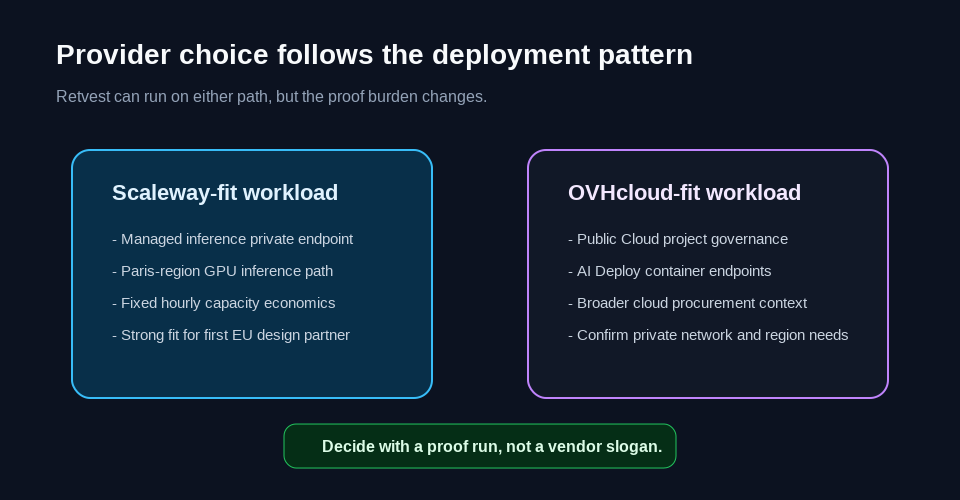
Scaleway's Managed Inference documentation says the service can deploy dedicated endpoints, supports private-network attachment, and states that models are hosted in Europe in the selected data center region. Its FAQ says Managed Inference is hosted in Paris, France, and differentiates dedicated hourly capacity from token-billed generative APIs. OVHcloud's AI Deploy pages describe container-based AI app deployment, Public Cloud project billing, GPU or CPU resources, monitoring, restricted authentication, and regions including Gravelines, France, with no multi-AZ support for AI Deploy in the capability page returned during this research. See Scaleway's Managed Inference FAQ, Scaleway's private network guide, Scaleway's AI data privacy page, OVHcloud's AI Deploy product page, and OVHcloud's AI Deploy capabilities page.
The first decision: managed inference or customer-operated stack
Private AI has two common shapes. In the first, the customer uses a managed inference service for the model endpoint while operating the application, database, vector store, and control plane elsewhere in the same cloud boundary. In the second, the customer operates more of the stack directly on Kubernetes or GPU instances, including the model serving layer.
Managed inference is attractive when the buyer wants faster time to first answer, predictable endpoint management, and less model-serving operations. It can be a strong fit for a first design partner if the service supports private network access, region requirements, IAM, monitoring, and model choices that match the customer's data policy. The tradeoff is that the customer accepts the provider's managed-service boundary and feature set.
Customer-operated serving is attractive when the buyer needs maximum control over model weights, serving configuration, network policy, node topology, release cadence, and observability. The tradeoff is operational burden. Someone has to patch, scale, monitor, and troubleshoot the serving layer. For an early enterprise pilot, that extra control is only worth it when the customer requires it.
Retvest should not force the most complex path by default. The deployment decision should match the customer's acceptance criteria. If managed private inference satisfies the no-egress, region, audit, and latency requirements, use it. If it does not, use Kubernetes and a self-operated serving path.
Where Scaleway looks strong
Scaleway looks especially relevant when the buyer wants a compact European deployment path with private inference networking. Its Managed Inference docs emphasise dedicated endpoints, model catalog or custom models, OpenAI API compatibility, private networking, IAM-compatible access, and observability through Scaleway Cockpit. Its data privacy page states that Managed Inference models are stateless for prompts and generated content, that prompts and completions are not used for training or base-model improvement, and that data is not accessible to other customers or underlying model creators.
Those statements do not remove the need for customer review. They do create a clearer proof path for a Retvest-style pilot:
- Deploy application components and inference in the same regional boundary.
- Attach inference to a private network.
- Use IAM and API keys for endpoint access.
- Keep customer documents, embeddings, and audit state in customer-owned services.
- Capture model endpoint metrics for latency and capacity planning.
- Document which data stays in Retvest components and which reaches the managed inference endpoint.
The main risk is dependency on a managed service that may not expose every low-level control a strict customer wants. The buyer should test model choice, throughput, context length, private-network setup, logging behaviour, and incident support before treating it as production-ready.
Where OVHcloud looks strong
OVHcloud is relevant when the customer already has OVH procurement, wants a broader Public Cloud relationship, or prefers AI Deploy's container-based application model. Its public product page highlights AI Deploy for production model and application endpoints, high availability, automatic load balancing across instances, API or CLI management, and certifications for cloud infrastructure and services. The capability page found during this session describes GPU and CPU resource selection, monitoring through a native Grafana dashboard, restricted authentication, object storage attachment in the same region, and the ability to deploy custom Docker images.
Those are useful primitives. The buyer still needs to verify details that affect private AI:
- Is the target AI service region acceptable for the customer?
- Does the specific AI Deploy path support the private networking pattern the customer requires?
- Are GPU types, quotas, and autoscaling enough for the expected workload?
- Can logs and monitoring be configured without storing customer prompts or document text?
- Does object storage location match the model endpoint region?
- What support SLA applies to the exact services used?
The OVHcloud capability page surfaced in this research says private networking via vRack is not supported for AI Deploy, while the product page makes a broad sovereign-cloud claim. That is not a contradiction as much as a reminder that marketing pages and service-specific docs answer different questions. A regulated buyer should use the service-specific docs for architecture decisions.
Do not compare only GPU price
GPU price matters, but it is rarely the first failure in regulated AI pilots. The pilot fails when identity integration is messy, private networking is not available, logs contain sensitive content, support cannot explain an outage, the model endpoint is in the wrong region, backups are untested, or the customer cannot export evidence for governance review.
A useful provider scorecard should include:
- Region and data-boundary proof.
- Private-network options for model endpoints and application services.
- GPU availability, quotas, and upgrade path.
- Kubernetes maturity and node-pool operations if self-hosting.
- Secret management and external secret support.
- Observability without raw customer content.
- Backup and restore path for databases, object storage, and vector stores.
- Image signing, SBOM, and vulnerability-scanning workflow.
- Support response and escalation model.
- Cost at idle, expected load, and peak load.
For Retvest, the first customer deployment should optimise for proof speed and operational clarity. A slightly higher GPU bill is acceptable if it avoids a month of network or compliance ambiguity. A cheaper path is not cheaper if it leaves the founder debugging provider limits during a design-partner review.
The proof packet should be provider-specific
Do not ship the same deployment appendix for every cloud. A Scaleway proof packet should show the exact Managed Inference region, private network attachment, IAM path, endpoint authentication posture, Cockpit metrics, and where Retvest stores documents, embeddings, audit events, and backups. An OVHcloud proof packet should show the exact Public Cloud region, AI Deploy or Kubernetes shape, authentication choice, GPU quota, object storage region, networking constraints, monitoring surface, and service-specific caveats.
This matters because customers do not buy "European cloud" in the abstract. They buy a deployment they can approve. If a provider does not support a needed private-network pattern for the selected AI service, the architecture must show the compensating control or choose a different service. If a managed inference service keeps prompts out of model training but can temporarily log abnormal traffic for security operations, the customer should know that before the pilot. If a GPU quota or region limitation affects load testing, it belongs in the plan rather than the incident report.
Provider-specific evidence also improves sales discipline. It stops Retvest from promising a generic sovereign deployment and forces the team to prove the actual one the customer will run.
Recommended first-pilot approach
For a first EU design partner, start with a provider-specific proof packet rather than a permanent cloud decision. The packet should include an architecture diagram, region statement, private networking evidence, IAM and secret path, metrics screenshot, backup plan, deletion plan, and a short failure-mode test. Run the same Retvest acceptance checks on each provider candidate:
- Can the app reach the model endpoint privately?
- Can public model access be disabled or tightly controlled?
- Can a synthetic corpus be ingested, queried, exported, and deleted?
- Can audit and metric outputs avoid raw prompts, answers, document text, and full identifiers?
- Can the deployment be upgraded and rolled back?
- Can the customer reproduce the evidence without vendor engineering help?
If Scaleway satisfies those tests faster, use Scaleway for the first deployment. If a customer's procurement or existing cloud standard points to OVHcloud, use OVHcloud but verify the AI Deploy networking and region details before committing. If neither managed path satisfies the boundary, run the model serving layer yourself on Kubernetes with the cost and operations burden stated up front.
The commercially stronger answer is not provider loyalty. It is a repeatable deployment proof that lets regulated buyers say yes without gambling on vague sovereignty claims.
Sources checked
- Scaleway: Managed Inference FAQ
- Scaleway: Use Managed Inference with a Private Network
- Scaleway: AI data privacy and security
- OVHcloud: AI Deploy product page
- OVHcloud: AI Deploy capabilities