Hybrid retrieval explained for enterprise RAG
Why regulated knowledge systems need lexical search, vector search, fusion, reranking, and evaluation instead of vectors alone.
Hybrid retrieval sounds like a technical implementation detail until a regulated buyer asks why the AI missed the most important document in the corpus. At that moment, retrieval quality stops being an ML benchmark and becomes a product liability, a support issue, and sometimes a compliance issue. The answer cannot be "the embedding model thought something else was closer." The system needs a defensible retrieval strategy.
Vectors are powerful because semantic similarity can find relevant passages that do not share exact words with the query. Keyword search is still powerful because legal terms, product names, policy IDs, drug names, ticker symbols, clause numbers, and internal acronyms often matter exactly. A private enterprise RAG product needs both. Hybrid retrieval is the discipline of combining those signals, measuring the result, and giving operators enough visibility to tune it.
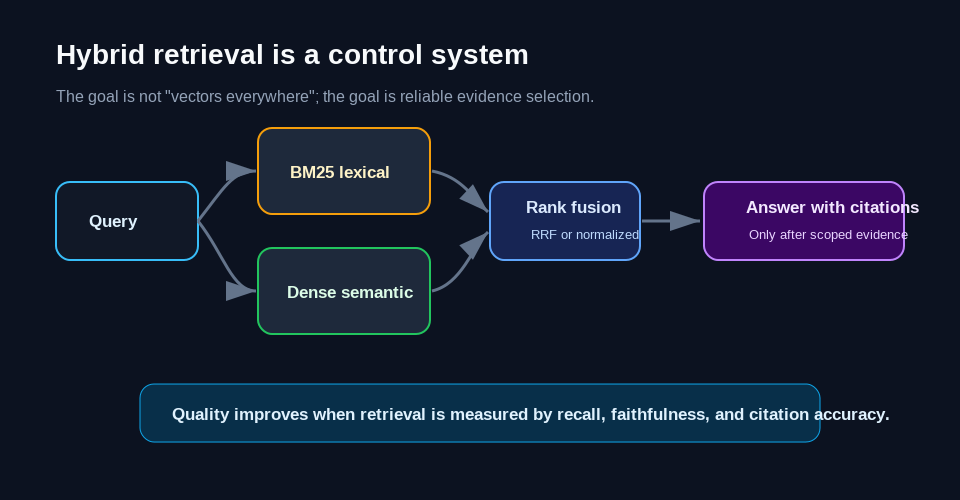
OpenSearch describes hybrid search as a combination of keyword and semantic search, with search pipelines that normalise and combine scores or use rank fusion. Elastic's hybrid search documentation similarly recommends reciprocal rank fusion for balancing lexical and semantic rankings. The specific engine is less important than the principle: retrieval should not depend on one similarity function when enterprise documents contain exact identifiers, paraphrases, tables, boilerplate, and domain language in the same corpus. See the OpenSearch hybrid search documentation and Elastic's hybrid search overview.
Why vector-only RAG fails in real companies
Vector search is good at approximate meaning. It is weaker when the query depends on exact tokens, rare identifiers, dates, named clauses, versioned policies, code-like values, or short phrases. Regulated enterprises are full of those. A lawyer may search for a clause reference. A compliance officer may ask about a specific control ID. A pharma team may use an assay name that appears in only one dossier. A finance team may care about a policy version, a desk name, or a regulator abbreviation.
Vector-only retrieval can also over-generalise. If the corpus contains several similar policies, semantic search may retrieve a passage that looks plausible but comes from the wrong jurisdiction, business unit, product line, or date. The answer can then be fluent and wrong. For a consumer chatbot that is annoying. For regulated enterprise workflows it is the failure mode that kills trust.
Keyword search has the opposite problem. It can find exact identifiers but miss relevant paraphrases. It can overweight boilerplate. It can struggle when the user asks a natural-language question instead of knowing the internal phrase. That is why the right conclusion is not "BM25 is better" or "vectors are better." The right conclusion is that retrieval needs multiple signals and an evaluation loop.
What hybrid retrieval actually does
A practical hybrid pipeline starts with the same user question but sends it down two or more retrieval paths. One path performs lexical retrieval, usually BM25 or an equivalent full-text scoring method. Another path performs dense vector retrieval over embeddings. More advanced systems add sparse vector retrieval, query decomposition, metadata filters, document recency, authority weights, or business-rule boosts.
The system then has to combine the candidates. Score normalisation tries to put scores from different retrievers onto a common scale. Rank-based fusion, such as reciprocal rank fusion, avoids relying on incomparable raw scores by rewarding documents that rank well across sources. After fusion, a reranker can inspect a smaller candidate set and reorder passages for the final prompt.
The important point is that the answer model should see scoped evidence, not a random bag of chunks. The pipeline should enforce tenant, collection, document, role, group, and user boundaries before candidates reach the model. It should also keep the candidate count bounded so latency and prompt cost do not explode.
A robust enterprise pipeline usually includes:
- Query validation and injection hardening.
- Tenant and collection filters applied before retrieval.
- Lexical retrieval for exact terms and identifiers.
- Dense retrieval for semantic recall.
- Rank fusion or calibrated score normalisation.
- Optional reranking for the top candidates.
- Citation assembly with document metadata and access-safe identifiers.
- Answer generation that is constrained to the selected evidence.
- Audit events that record bounded retrieval metadata.
That is more work than calling an embedding endpoint and a chat endpoint. It is also what makes the system supportable.
Evaluation matters more than architecture diagrams
Hybrid retrieval can still be bad. It can overweight keyword matches, retrieve duplicate chunks, bury the only relevant passage, or slow the system enough that users abandon it. A system is not credible because it says "hybrid" in a slide. It is credible because it measures retrieval quality on a representative corpus.
For Retvest, the minimum useful metrics are recall at k, faithfulness, citation accuracy, and latency. Recall asks whether the right evidence appeared in the candidate set. Faithfulness asks whether the answer stuck to that evidence. Citation accuracy asks whether the cited passages actually support the claims. Latency asks whether the workflow is usable at normal load.
The evaluation set matters. Generic benchmarks can be useful for engineering sanity, but regulated buyers need domain-like questions. A legal customer needs legal questions. A life-sciences customer needs regulated R&D and quality questions. A financial-services customer needs policy, risk, compliance, and investment-operations questions. The point is not to overfit a demo corpus. The point is to catch retrieval failures before a customer catches them during a pilot.
Good retrieval evaluation includes failure cases:
- A query with an exact policy ID.
- A query that uses a synonym not present in the document title.
- A query where the newest version should beat the old version.
- A query where one collection has a tempting but inaccessible answer.
- A query where no grounded answer should be returned.
- A multilingual query if the deployment claims multilingual retrieval.
- A long multi-turn question that depends on conversation history.
Without these cases, a demo can look better than the production system will behave.
Tuning should be boring and documented
Hybrid retrieval gives teams more knobs, which means it can create more confusion if tuning is informal. A serious deployment should document the chunking strategy, embedding model, lexical analyser, metadata filters, fusion method, reranker, top-k values, citation rules, and refusal behaviour. When one of those settings changes, the team should know which evaluation set improved, which one regressed, and whether latency stayed inside the user experience budget.
This is especially important for first customer deployments because early teams are tempted to tune against anecdotes. A lawyer says one answer was bad, so the team changes top-k. A compliance user says a phrase was missed, so the team changes chunk size. A demo query improves, but a different vertical gets worse. That is not engineering discipline. It is search superstition.
The healthier process is small and repeatable. Keep a golden set. Run the baseline before changing retrieval. Change one material parameter at a time. Record the metric movement. Attach the report to the release note. If a customer-specific override is needed, document why it exists and what risk it accepts. That level of discipline is not heavyweight. It is how a RAG product keeps trust after the initial demo glow fades.
Hybrid retrieval and security are connected
Search quality and access control are not separate concerns. If a retrieval pipeline first gathers candidates from every document and then filters them later, the system may leak through timing, logs, intermediate traces, citations, or model context. In a regulated deployment, access control needs to be part of candidate generation.
That affects data modelling. Document chunks should carry collection and tenant metadata in the vector store. Document moves should update vector payloads before or within the persistence boundary that changes source-of-truth metadata. Group membership changes should invalidate access quickly enough for the customer risk model. Conversation history should not let a shared thread expose cited content after collection access is revoked.
Hybrid retrieval also affects observability. Operators need to know whether poor answers come from empty retrieval, weak lexical matching, embedding drift, reranker failure, permission filters, LLM refusal, or latency timeouts. A single "answer failed" metric is not enough. The retrieval layer should produce privacy-safe counters and traces that explain the stage without dumping the customer's documents into logs.
What a buyer should ask
Ask vendors to show the retrieval path with evidence:
- Which search methods are used and why?
- How are lexical and semantic candidates combined?
- Are ACL filters applied before candidate generation?
- How are duplicate chunks, stale versions, and deleted documents handled?
- What metrics prove recall, faithfulness, citation accuracy, and latency?
- Can the customer provide a golden set for acceptance testing?
- What happens when the vector store, reranker, or LLM backend is down?
- Do audit logs include raw prompts or only bounded metadata?
The answers reveal whether the vendor built a product or a demo. For regulated enterprise AI, hybrid retrieval is not a feature checkbox. It is the retrieval control plane that makes grounded answers possible.
Sources checked
- OpenSearch: Hybrid search documentation
- Elastic: Hybrid search overview
- Retvest AI: Security and trust