EU AI Act primer for private enterprise AI
A practical guide for regulated teams turning AI Act obligations into operating evidence for private knowledge systems.
The EU AI Act is easy to misunderstand if it is treated as a checklist that legal owns after the product is already live. For regulated enterprises, the better interpretation is operational: every important AI workflow needs a known purpose, a risk classification, human accountability, traceable data handling, and evidence that can be reviewed without reconstructing history from Slack messages and half-remembered architecture diagrams.
That matters for private enterprise AI because most internal knowledge systems will not begin life as medical-device software, credit scoring, hiring automation, or another obviously high-risk use case. They begin as search, summarisation, drafting, and question answering over sensitive internal documents. That can sound low-risk until the system starts influencing legal advice, regulated customer responses, investment decisions, safety procedures, or employee outcomes. The risk is not the chat box. The risk is the business process into which the output is inserted.
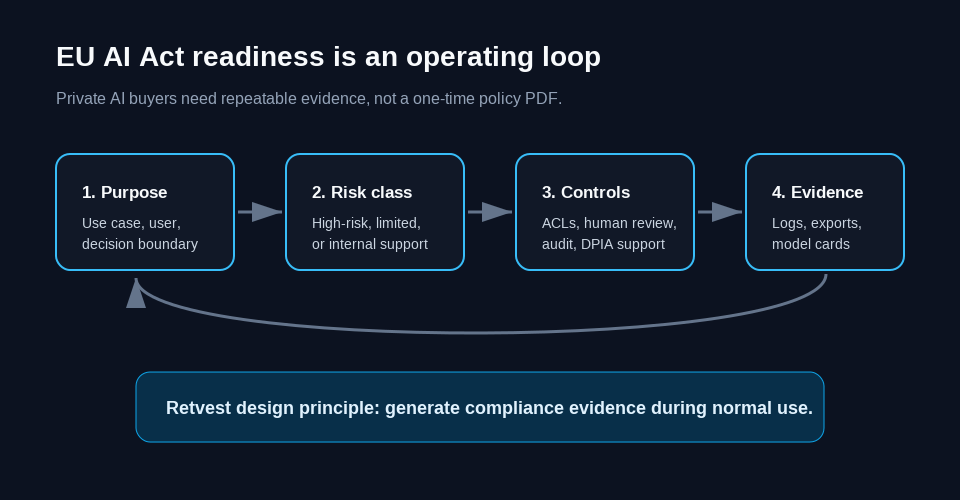
The European Commission describes the AI Act as a risk-based framework. Its public FAQ says the law applies to public and private actors that place AI systems or general-purpose AI models on the EU market, or put them into service or use them in the EU. It also says most AI systems can be developed and used under existing law without additional AI Act obligations, while high-risk systems carry requirements around risk management, data quality, documentation, traceability, transparency, human oversight, accuracy, cybersecurity, and robustness. The operational implication is simple: do not guess. Record the intended purpose and classify the workflow before the pilot becomes business critical. See the Commission's AI Act FAQ and the official Regulation (EU) 2024/1689 text.
Start with intended purpose
The first control is not a model card. It is a sentence that says what the system is and is not meant to do. "Internal legal knowledge assistant" is too vague. "Question answering over approved employment-law guidance for lawyers, with citation review before client advice" is better. It names the corpus, the user, the output shape, and the human decision boundary.
That sentence drives the rest of the evidence. If the system answers employees directly about termination rights, the risk profile changes. If it is used by a lawyer to find cited passages before drafting, the control model can be different. If it decides who receives a benefit, it is no longer a knowledge tool. Private AI vendors and customers should force that distinction early because ambiguity is where procurement, data protection, and security teams get stuck.
The useful questions are concrete:
- Who is allowed to use the workflow?
- Which documents can it retrieve from?
- What decision can the output influence?
- Who reviews the output before it leaves the team?
- What logs prove the retrieval and answer path later?
- What happens when the model refuses, hallucinates, or cites stale material?
These questions are not bureaucracy. They are the difference between an internal assistant that is tolerated and an AI workflow that can survive audit.
Map risk class to controls
Many enterprise RAG systems will start outside the high-risk categories if they are truly advisory, internal, and human-reviewed. That does not mean the buyer can ignore governance. GDPR, professional secrecy, financial regulation, sector-specific retention rules, contractual confidentiality, and employment law still apply. The AI Act adds another layer when the workflow crosses into a listed high-risk use case or when the provider or deployer obligations become relevant.
High-risk systems need a more formal control set. The Commission FAQ names provider obligations such as conformity assessment, quality management, public database registration where required, lifecycle responsibility, incident handling, and cooperation with authorities. It also names deployer obligations such as using the system according to instructions, assigning human oversight, monitoring operation, acting on risks and serious incidents, and ensuring input data is relevant where the deployer controls that data. Those words become engineering requirements when a system is deployed inside a regulated enterprise.
For a private knowledge product, a practical control map looks like this:
- Access control: retrieval must respect user, group, role, collection, and document boundaries.
- Data minimisation: logs and metrics should not store prompts, answers, file text, secrets, or full identifiers unless an explicit customer policy says so.
- Traceability: every answer should be reproducible enough to show which documents and model configuration were involved.
- Human oversight: the product must make review easy, not merely mention that humans are responsible.
- Change control: model, prompt, retrieval, and deployment changes need release notes and rollback paths.
- Incident response: bad answers, broken access control, audit-chain failure, and data exposure need named runbooks.
The exact mapping depends on the use case, but the habit should be consistent: policy language becomes product behaviour, and product behaviour produces evidence.
Evidence should be generated during normal use
Compliance evidence that has to be manually rebuilt after a customer asks for it is fragile. The system should create a durable record as it runs. That does not mean storing every raw prompt and answer forever. In fact, for private AI it usually means the opposite. Store the minimum evidence needed to prove boundary, configuration, actor, and outcome. Keep raw content inside the customer deployment and under the customer's retention policy.
Retvest is designed around that principle. Customer content stays in the customer environment. Retrieval is collection-scoped. Audit events use bounded metadata. Compliance exports include technical documentation, model metadata, audit proof, data-processing registers, and conformity checklist state. The goal is not to replace counsel. The goal is to prevent the DPO, CISO, and platform team from starting with an empty folder when someone asks how the system was controlled.
Good evidence answers questions such as:
- Which user or service account ran the workflow?
- Which collection or document boundary applied?
- Which model, embedding model, retrieval configuration, and prompt version were active?
- Which citations supported the answer?
- Was the workflow streamed, retried, rate-limited, or blocked?
- Did the output enter a high-risk decision path or stay in an advisory review loop?
If the answer to those questions is "we can probably infer it from logs", the system is not ready for regulated use.
What to prepare before the first pilot
The fastest way to make AI Act readiness practical is to put the evidence questions into the pilot plan. Before a design partner uploads real documents, the vendor and customer should agree on the pilot's intended purpose, the user groups, the allowed document collections, the review workflow, the retention settings, the incident path, and the success metrics. That agreement does not need to be a 60-page governance binder. It does need to be specific enough that the deployment team can configure the product and the customer can judge whether the pilot stayed inside the promised boundary.
This is also where many pilots become commercially weak. A vendor wants to move fast, so it accepts vague success criteria. The customer wants to experiment, so it avoids naming the decision process. Four weeks later, nobody agrees whether the result was good enough. For regulated AI, ambiguity is expensive. The pilot should say which questions will be tested, which documents are in scope, which answers require human review, what evidence export will be inspected, and what failure modes would pause or stop the pilot.
That structure helps both sides. The customer gets governance evidence before production. The vendor gets a fair test instead of a generic "AI exploration" that can never close. AI Act readiness is not only legal defensiveness. It is a way to turn a risky proof of concept into a measurable buying process.
Private deployment changes the compliance conversation
Running in the customer's VPC does not magically solve the AI Act. It does change the evidence boundary. The customer can inspect infrastructure, control network egress, apply its own identity provider, keep documents and embeddings inside its environment, and retain logs according to its policy. That gives the customer stronger deployer control than a generic SaaS chat product can usually offer.
The tradeoff is operational responsibility. A customer-controlled deployment needs clean Helm values, sealed secrets or external secret support, backup and restore procedures, alerting, release verification, and runbooks. A private AI vendor cannot claim sovereignty while leaving the buyer to discover that metrics contain raw prompts or that rollback requires a staff engineer on a video call. The product has to make the deployment boring.
For first pilots, this means the success criteria should include evidence quality as well as answer quality. A good pilot should prove that the system can retrieve accurately, answer faithfully, preserve citation boundaries, export compliance evidence, survive permission changes, and show operators what broke when a dependency fails.
A buyer checklist
Use this checklist before buying or deploying a private enterprise AI system:
- Intended purpose is written and narrow enough to classify.
- High-risk, limited-risk, or internal-support posture is documented.
- Human review is tied to real workflow steps.
- Access control is enforced before retrieval, not only before display.
- Prompt, answer, citation, and document retention are explicit.
- Model and retrieval configuration are versioned.
- Audit events avoid customer content unless the customer opts in.
- Evidence export works from the admin interface.
- Incident and rollback runbooks exist.
- Evaluation metrics include retrieval recall, faithfulness, citation accuracy, and latency.
That is the level of evidence a regulated buyer should expect. A demo chatbot can be impressive in ten minutes. A compliant private AI system has to be explainable six months later.
Sources checked
- European Commission: Navigating the AI Act
- EUR-Lex: Regulation (EU) 2024/1689
- Retvest AI: EU AI Act product page