Aleph Alpha Pharia vs Retvest
A sober comparison of Aleph Alpha Pharia and Retvest for buyers evaluating sovereign AI and private enterprise RAG.
Aleph Alpha is one of Europe's most credible sovereign AI companies. It has a serious research history, a German enterprise and public-sector posture, and a clear narrative around transparency, control, and compliance. A Retvest buyer comparing Retvest with Aleph Alpha Pharia should not be told that Pharia is irrelevant. That would be weak positioning. The better answer is to explain the category difference.
Pharia is a broad sovereign AI stack. Retvest is a focused private enterprise knowledge product: "Glean, but it runs in your VPC." Those two descriptions can overlap in a procurement conversation, but they do not imply the same buying motion, deployment work, or time to first value. The useful question for a buyer is not "Which company sounds more sovereign?" It is "Do we need a strategic AI platform partner, or do we need a controlled private RAG deployment that can ingest documents, enforce ACLs, answer with citations, export compliance evidence, and pass a pilot quickly?"
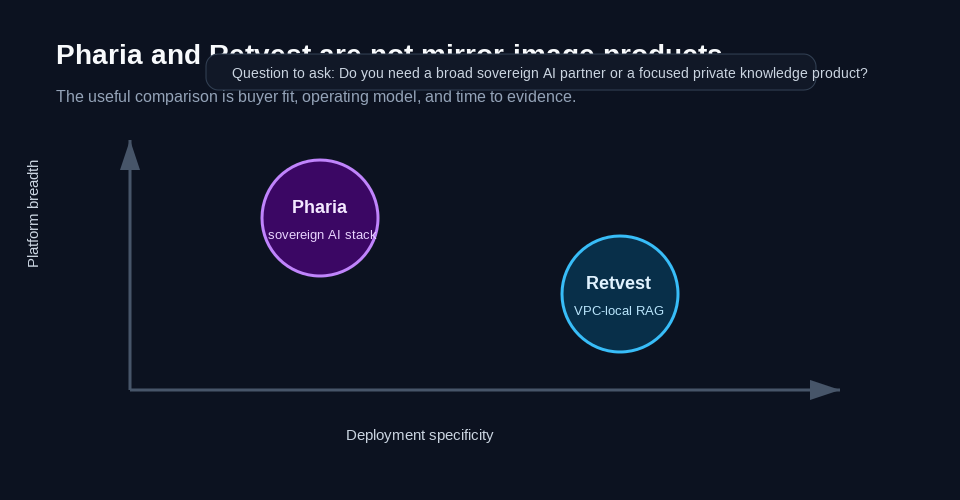
Aleph Alpha's Pharia announcement describes PhariaAI as a sovereign operating system for generative AI applications in enterprises and public administration, with hybrid execution, explainability, and auditability. Aleph Alpha's own company page says it was founded in 2019 to research and build sovereign, human-centric AI, and says its products are built to support technological sovereignty for enterprises and governments. Its Pharia-1 material highlights a 7B model family, multilingual optimisation, control-oriented response behaviour, and published research details. See Aleph Alpha's PhariaAI announcement, company page, and Pharia-1 model post.
Where Pharia is likely strong
Pharia is likely strongest when the customer wants a broad sovereign AI relationship and has the budget, time, and internal programme structure to absorb it. That may include public-sector deployments, large industrial transformation programmes, German-language or European sovereignty mandates, strategic model partnerships, explainability-heavy workflows, and senior stakeholder alignment around an enterprise AI platform.
That breadth can be a strength. Some buyers do not want a narrow product. They want a partner that can help define a multi-year sovereign AI operating model. They may care about model research, explainability, customised solutions, and a strategic vendor posture. Aleph Alpha is built for that conversation.
Retvest should not pretend to win that same conversation by being smaller. The right response is to qualify. If the buyer wants a major sovereign AI platform programme and expects vendor-led transformation across many application families, Pharia may be the more natural shortlist entry. Retvest's wedge is different: deploy a controlled private knowledge assistant with evidence, not run a broad AI transformation programme.
Where Retvest should be sharper
Retvest should win when the buyer has a specific blocked workflow:
- Sensitive documents cannot leave the customer's environment.
- Employees need knowledge search and grounded Q&A, not a model strategy deck.
- Security wants SSO, collection ACLs, audit, signed releases, and rollback.
- Legal and compliance want EU AI Act evidence exports and privacy-minimised logs.
- The buyer wants a two-month POC with measurable retrieval quality.
- The team does not want to hire an AI platform group before seeing value.
That is a narrower ask, and that is commercially useful. Narrow products are easier to buy when the pain is clear. Retvest can define a tighter success scorecard: ingest a corpus, enforce access, answer questions with citations, measure recall and faithfulness, export compliance evidence, and prove the deployment can be operated.
The product should avoid claiming to be more sovereign in the abstract. Instead, it should show the concrete boundary: customer VPC, customer-owned content, deployment-local database and vector store, no customer documents in Retvest's control plane, privacy-safe audit events, and compliance bundles generated from the customer's environment.
The buyer's decision tree
A simple decision tree is more persuasive than a feature grid.
Choose a broad sovereign AI platform path when:
- The buyer has executive mandate for an AI platform programme.
- Multiple custom AI applications are in scope.
- The organisation wants vendor help with model, application, and governance strategy.
- The budget and timeline support a strategic platform implementation.
- Explainability, model customisation, and public-sector-grade sovereignty are the core buying themes.
Choose a focused private RAG product when:
- The first use case is enterprise knowledge search and Q&A.
- The buyer already knows which corpus and users matter.
- The security blocker is data boundary and access control.
- The compliance blocker is evidence and auditability.
- The success metric is pilot value in weeks, not programme maturity in years.
- The customer wants to run the system in its own VPC or cloud account.
This framing respects Aleph Alpha while making Retvest's reason to exist clear. The goal is not to win every sovereign AI deal. The goal is to win the deal where a buyer says, "We need private Glean-like knowledge retrieval, we need it inside our boundary, and we need evidence for security and compliance."
What Retvest must prove
Positioning only works if the product evidence supports it. Retvest cannot win against a larger sovereign AI platform with vibes. It has to prove a narrower claim with more operational specificity.
The proof points should include:
- A clean customer VPC deployment path.
- SSO and group-based access control.
- Collection-scoped retrieval and document-level overlays.
- Permission revocation tests that hide stale retrieval paths.
- Conversation threads that do not bypass document access.
- Bounded audit events that avoid raw prompts and file text.
- Compliance bundle export with model, retrieval, audit, and data-processing evidence.
- Golden-set evaluation for recall, faithfulness, citation accuracy, and latency.
- Signed images, SBOMs, runbooks, health checks, and rollback steps.
If those proof points are weak, Retvest should not hide behind a comparison post. It should fix the product. The strongest objection to Retvest is not that Aleph Alpha exists. It is that a narrow private RAG product must be extremely credible on deployment, security, and retrieval quality because it does not have platform breadth as a fallback story.
How Retvest should avoid the commodity trap
The risk for Retvest is not only losing to Pharia. The larger risk is being perceived as another RAG wrapper. That happens if the product conversation focuses on chat UI, model choice, or generic "ask your documents" copy. Those features are easy to copy and hard to defend. Regulated buyers will only care if Retvest makes the blocked part of adoption easier: security review, data boundary proof, access control, retrieval evaluation, evidence export, and pilot execution.
That means the roadmap should stay disciplined. More connectors matter only if ACLs and drift repair stay correct. More models matter only if evaluation and model-card evidence stay current. More UI polish matters only if the product still exposes loading, failure, citation, and permission states honestly. A narrow product can beat a broad platform in a narrow deal, but only when the narrow product is operationally sharper.
This also shapes pricing and qualification. Retvest should not chase teams that want a free chatbot experiment. It should chase teams where a private deployment removes a real blocker and where a successful POC can become a paid annual contract. That is how the comparison stays strategic instead of defensive.
How to talk about the comparison
The sales language should be calm:
- "Aleph Alpha is a credible sovereign AI platform company."
- "Retvest is a focused private knowledge product for regulated teams."
- "If you need a broad strategic AI platform, include Pharia in the evaluation."
- "If your immediate blocker is private enterprise search and grounded Q&A inside your VPC, evaluate Retvest on deployment proof, ACLs, retrieval quality, and compliance export."
That language avoids false rivalry. It also prevents the founder from wasting time in platform bakeoffs where Retvest is not yet designed to win. The first revenue path is more likely to come from teams that have a concrete knowledge workflow and a blocked SaaS AI rollout than from organisations trying to pick a national AI champion.
What to ask in procurement
A buyer comparing Pharia and Retvest should ask both vendors:
- Where do customer documents, embeddings, prompts, answers, logs, and audit evidence live?
- Can the system run inside our cloud account or VPC?
- How are user and group permissions enforced before retrieval?
- What evidence proves citation accuracy and faithfulness?
- What happens when access is revoked after a conversation already cited a document?
- How are model, prompt, retrieval, and deployment changes versioned?
- What support access does the vendor have to our environment?
- Can we export compliance evidence without custom services work?
- What is the first eight-week POC success scorecard?
The answers will usually reveal whether the buyer needs a platform partner or a focused private RAG product. Retvest should be comfortable with either outcome. Bad-fit deals consume founder time and produce weak references. Good-fit deals produce narrow proof, faster cycles, and a clearer product.
Sources checked
- Aleph Alpha: PhariaAI announcement
- Aleph Alpha: Company page
- Aleph Alpha: Pharia-1 model post
- Retvest AI: Trust page